
Thanksgiving week is one of my favorite times in San Antonio. Kids are out of school, families are on the road, and everyone seems to be heading somewhere with a pie, a bag of tamales, or an overnight bag in the backseat. But as much as I love this season, it is also the time of year when we see a big jump in deer-related collisions coming through our doors.
If you drive through New Braunfels, Bulverde, Boerne, Canyon Lake, Helotes, or any part of the Hill Country after sunset, you already know how common deer crossings are. What many people do not realize is that November is the peak month for deer movement in Texas. Between the time change, earlier sunsets, cooler mornings, and rut season, deer are more active, less predictable, and crossing our roads at the exact times families are driving to and from Thanksgiving gatherings.
As someone who has repaired collision damage for more than a decade and as a mom who drives these same roads with my own kids, I want you to be prepared. A deer collision can be traumatic, especially when it happens suddenly in the dark. And even when the damage looks minor, the hidden problems underneath are often far more serious than what you see on the surface.
My goal with this guide is to help you understand why deer collisions spike during Thanksgiving travel, what actually happens to your vehicle during impact, and what steps to take to protect your family and your car. With the right knowledge, you can stay safer, make smarter decisions, and avoid driving with hidden damage that could leave you stranded over the holiday weekend.
Why November Brings So Many Deer Collisions in Texas
Every year around this time, I start to see the same pattern in the shop. The mornings get cooler, the sun sets earlier, families begin planning those Thanksgiving drives, and then the deer-hit vehicles start to roll in one after another. It happens so consistently that I can almost predict the week it will start.
If you have ever driven through Bulverde, New Braunfels, Boerne, or Helotes in November, you already know the feeling. One moment the road is calm and quiet, and the next moment a deer leaps out of the brush so fast you barely have time to react. There is something about this season that brings them out everywhere.
A big part of it is the rut. November is mating season, and the deer are not paying attention to anything except each other. They travel longer distances, cut across open roads, and dart through neighborhoods that normally stay quiet the rest of the year. I always tell customers that during rut season, the deer are not acting like themselves. They move differently, they hesitate less, and they cross roads without that usual pause or glance.
Where Deer Collisions Happen Most Around San Antonio and the Hill Country
If you have lived here long enough, you start to notice the spots where deer always seem to appear. I hear it from customers all the time. “It was right by Natural Bridge.” “It happened on 46 again.” “They came out near Camp Bullis.” These are conversations I have every single November, and they are always almost identical.
There are certain roads around San Antonio and the Hill Country where deer collisions happen year after year. It does not matter how much construction goes on or how many new homes go up. The deer still follow the same patterns. They move along creek beds, pastures, and tree lines, and those paths cut right across human traffic in some of the busiest growing areas around us.
Highway 46 is one of the most common places we hear about. If someone walks into the shop with front-end damage from hitting a deer, there is a good chance they were coming from Bulverde or New Braunfels. That stretch of road sees heavy deer movement at dusk, especially after rain or sudden temperature drops.
Another hotspot is FM 3009 near Natural Bridge Caverns. That whole area is surrounded by wildlife corridors, and once the sun starts to set, deer come out fast. Customers tell me they barely had time to tap the brakes before impact.
Loop 1604 on the North side, especially near Camp Bullis and The Dominion, is another area where I see a lot of damage. The deer population around the base is high, and they cross the highway without hesitation. Even with all the traffic, they still move through the same access points they have used for decades.
Boerne, Fair Oaks, Canyon Lake, and the backroads leading into the Hill Country are all places where I instantly become more alert when I am driving with my own kids. As beautiful as those areas are, they are also some of the highest deer-activity zones in the state.
What makes these places so risky is how quickly the environment changes. One minute you are driving past restaurants and shopping centers, and the next you are surrounded by brush and tree lines that hide deer until the last possible second. You can go from bright city lights to pitch-black rural road in less than a mile.
So when customers tell me, “I never even saw it,” I understand completely. In these areas, that is exactly how it happens.
The Damage You Can’t See After a Deer Hit
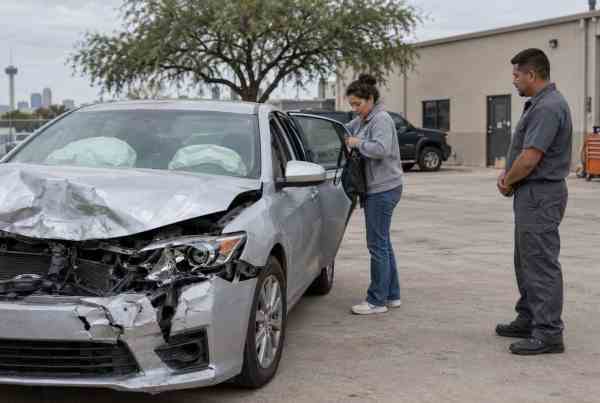
When a deer hits your car, the first thing you notice is usually the obvious: the cracked bumper, the bent hood, maybe a broken headlight hanging by a wire. But almost every time one of these vehicles comes into the shop, the real trouble is hiding underneath what you can see.
I cannot count how many times someone has walked in telling me the damage did not look too bad until they started hearing a strange rubbing sound or the temperature gauge began climbing halfway through the drive. Deer hits are sneaky like that. The impact might seem small, but the force transfers through the entire front of the car in ways you would never expect.
One of the places damage likes to hide is behind the bumper. The bumper cover is just plastic. The real protection is behind it. When a deer impacts the front, that energy travels straight into the metal structure that holds your radiator, your AC condenser, and all of your front sensors. Even if the bumper only looks cracked, the support behind it can be bent, cracked, or shifted out of place by as little as half an inch. That seems tiny, but in collision repair, half an inch is a big problem.
Then there are the sensors. Modern vehicles rely on them for almost everything. Adaptive cruise, emergency braking, lane departure, parking distance, airbag timing. They all depend on sensors that sit right in the areas that get hit in a deer impact. If one of those loses alignment during the collision, you may not notice anything right away. But the next time you are driving at night, the system may not warn you when you drift too close to another car. It is the kind of problem that stays quiet until the moment you really need it.
I remember a customer who came in thinking she just needed a new headlight. The deer had hit her low on the bumper, and from the outside it really did not look like much. But when we got inside the front end, we found a cracked radiator support and a wiring harness that had been pinched during the impact. She told me her car had been making a strange humming noise for days but she assumed it was unrelated. It was absolutely related.
Alignment is another issue people underestimate. Even a slight shift from a deer impact can throw the alignment off, and you may not feel it until you hit the highway. A little drifting, a little vibration, a little pulling to the right. By the time you notice it, your tires have already started wearing unevenly. Deer hits do not just bend metal. They shift the entire geometry of the front end.
This is why I always tell customers that after a deer hit, the outside damage is only half the story at best. The inside tells the truth. And I would rather find the truth early, before you end up stranded on the side of I-35 with smoke coming from your radiator or a dashboard full of warning lights.
Insurance 101 — Is Deer Damage Covered?
One of the first things people ask after a deer hit is, “Is this even going to be covered?”
You can see the stress in their face. It is always the same mix of relief that everyone is safe and fear that the repair bill is about to ruin their holiday budget.
The good news is that in almost every case, deer collisions are covered. And not under the part of your insurance that raises your rates for years afterward. Deer impacts fall under comprehensive, which is the same category as hail, vandalism, and theft. Collision is for hitting another vehicle. Comprehensive is for hitting… well… life. And deer definitely fall under that category here in Texas.
I always see people relax a little when I explain that. Comprehensive claims typically do not count against you the way at-fault collision claims do. Most carriers treat deer as unavoidable, especially in states like ours where wildlife crossings are part of everyday life.
What usually surprises people is how simple the process can be when you have the right documentation. A few good photos of the scene, a quick call to your carrier, and then the rest becomes our job. We work directly with insurance every single day, so we know exactly what they look for and how to present the damage so there are no delays. During the holidays, when you are balancing family, travel, and a thousand little details, handing that part off to someone else can make all the difference.
I want you to feel confident about this. A deer collision is frustrating, sometimes scary, and always inconvenient. But from an insurance perspective, it is one of the more straightforward claims you can make. If you ever feel unsure or you are not getting clear answers from your carrier, call us. We deal with this all the time, and I would rather walk you through the process than see you stress over something that can be handled quickly.
Is Your Car Safe to Drive After a Deer Hit?
One of the hardest conversations I have with customers happens right after a deer collision. They come in still unsettled, replaying the moment of impact, trying to convince themselves the car is “probably fine.” I understand the instinct. You want everything to go back to normal. You want the holiday plans to stay on track. You want the car to just… work.
But here is the honest truth: after a deer hit, the outside of the vehicle rarely tells the full story about whether it is safe to drive.
Sometimes the car looks “driveable,” but the hood no longer latches securely, which means it could fly up at highway speeds. Sometimes the lights appear intact, but the beam pattern is misaligned enough to reduce your visibility at night. Sometimes the bumper looks cracked but manageable, but underneath it the radiator support is fractured, slowly leaking fluids that will eventually lead to overheating.
I remember one customer who told me the only reason she brought her car in was because something “just felt off.” She could not explain it. It was not making a loud noise. It was not pulling dramatically. But she trusted her intuition. When we inspected the vehicle, we found a bent tie rod and a slight shift in the frame rail. If she had taken that car on her Thanksgiving road trip as planned, it could have turned into a much more dangerous situation.
That is usually how hidden damage shows itself. It whispers before it screams. A soft vibration in the steering wheel. A faint smell after driving a while. A light that flickers once and then disappears. And right around the holidays, when our roads are colder, wetter, and busier, those small issues can turn into big ones quickly.
You deserve to know your car will protect you. You deserve peace of mind when you load your kids in the backseat or head out to see family. If something about your vehicle feels different after a deer hit, trust that feeling. You do not have to guess or Google your way through it. We can tell you exactly what is going on and whether it is safe for the road or needs immediate attention.
When You Need Scanning and Calibration After a Deer Collision
If your car was built in the last ten to fifteen years, there is a very good chance it depends on technology that sits right behind the area a deer usually hits. Forward-facing cameras, radar sensors, crash sensors, lane assist modules, wiring harnesses, and the entire front ADAS system live in your bumper, grille, fenders, and windshield. That is exactly the region that absorbs the impact during a deer collision.
This is why scanning and calibration matter more after a deer hit than almost any other type of accident.
People are often surprised when I explain that even a glancing blow can unsettle these systems. They assume sensors either break or they do not, but it is not that simple. Many of these components rely on incredibly precise alignment. A millimeter of shift can cause the system to misread the distance between your car and the car in front of you. A small crack in a mounting bracket can throw off your radar beam. A wiring harness that took a jolt during the collision might not fail immediately, but it can begin failing slowly over time.
I once worked on a vehicle where the only visible damage was a dented bumper cover. No leaks. No broken lights. No warning lights on the dash. But the owner mentioned that her adaptive cruise control felt “a little weird” on her drive home. When we scanned the car, we found multiple stored codes indicating the radar had been knocked off its intended angle. If she had taken that car on her Thanksgiving trip, her braking system would not have reacted the way she expected if traffic slowed suddenly.
This is why every deer-hit vehicle we repair goes through both a pre-scan and a post-scan. A pre-scan tells us what was affected by the impact. A post-scan confirms that every sensor, module, and system is back within manufacturer specifications. Modern vehicles are designed to protect you using those systems. They only work correctly when they are calibrated correctly.
And calibration is not a “guess and check” process. It requires specialized equipment and a controlled environment. We use industry-leading tools and follow OEM repair procedures because technology is unforgiving. You cannot eyeball a forward radar and hope it functions the way it should. You cannot assume a lane departure camera is fine just because the car drives straight. A deer impact can shift things in ways that only show up when you look at the data.
If your vehicle has even one of these features:
-
adaptive cruise control
-
lane keep assist
-
collision avoidance
-
blind spot monitoring
-
automatic emergency braking
then calibration after a deer collision is not optional. It is part of restoring your car to the safety level it had before the impact.
You deserve a vehicle you can trust, especially with holiday travel ahead. Scanning and calibration are how we make sure of that.
How Our Shop Helps During Holiday Travel
The days leading up to Thanksgiving are some of the busiest travel days of the entire year in Texas. I see families rushing to finish work, kids bouncing between school events and holiday plans, and parents balancing grocery lists, road trips, and a hundred small things that need to get done before Thursday. When a deer collision suddenly gets added to that list, it can feel overwhelming.
This is exactly why we take a different approach during the holiday season. When a vehicle comes in after a deer hit, I know you are not just looking for a repair. You are looking for reassurance. You want to know your vehicle is safe for long miles, late-night drives, and hill country highways. You want to know nothing is being overlooked. You want the truth about what needs attention and what can wait. And you want all of that from someone who understands what this season is really like for families here in San Antonio.
That is why we start with a full assessment instead of a quick visual estimate. We look behind the bumper. We measure the frame. We check the alignment. We scan every sensor and calibration system. We check for leaks, structural shifts, mounting point damage, and wiring issues that can fail once the vehicle heats up on the highway. We do not rush this step, because your safety at 75 miles per hour matters more than anything else.
If repairs are needed, we follow OEM procedures from start to finish. That means using structural measurements, approved parts, and recognized repair methods, not shortcuts. We use waterborne Spies Hecker paint for perfect color match, even on newer vehicles and luxury models. And before your vehicle ever leaves the shop, we verify calibration, sealing, alignment, and system performance. Holiday travel brings unpredictable weather and unpredictable traffic. You need a car that performs exactly the way it was designed to.
We also help with the parts that stress people out the most. Insurance paperwork. Claim updates. Scheduling. Transportation options. Our goal is to take the weight off your shoulders so you can focus on your family and your plans, not your car.
I know how special this season is. I know the feeling of loading everyone up, snacks packed, music playing, ready to head out for Thanksgiving. And I want you to make that trip with confidence. No doubts. No last-minute warning lights. No “I hope this holds up.”
We will treat your vehicle the same way we treat our own. Thoroughly, carefully, and with the level of attention it deserves during the busiest travel week of the year.
Stay Safe, Stay Prepared, and Enjoy Your Thanksgiving
Thanksgiving should feel peaceful. It should feel warm and connected. It should feel like family piled into the car, taking the long way past the lights, talking about pies and football and the little things you are thankful for this year. What it should not feel like is fear or uncertainty about whether your vehicle is safe to drive.
I have lived in San Antonio long enough to know that deer collisions are simply part of life here, especially in November. They happen to careful drivers, experienced drivers, new drivers, and everyone in between. And every single time, the person behind the wheel walks away feeling shaken and unsure of what to do next. If that is where you are right now, let me reassure you. You are not alone, and you do not have to figure this out by yourself.
Your safety and your confidence matter to us. Whether the damage looks big or small, we can tell you what is really going on and what the next steps should be. And we will walk through it with you so you can get back to enjoying your holiday without worrying about what the impact may have done beneath the surface.
If you were involved in a deer collision recently, or if you are preparing for Thanksgiving travel and something about your car just feels “off,” bring it to us. Even a quick inspection can give you clarity and peace of mind. We will check what needs checking, repair what needs repair, and make sure your vehicle is ready for the miles ahead.
If you need help or want your vehicle inspected before the holiday, call us at (210) 405-8817.
You and your family deserve to be safe, steady, and confident on the road this week. We are here to help make that happen.